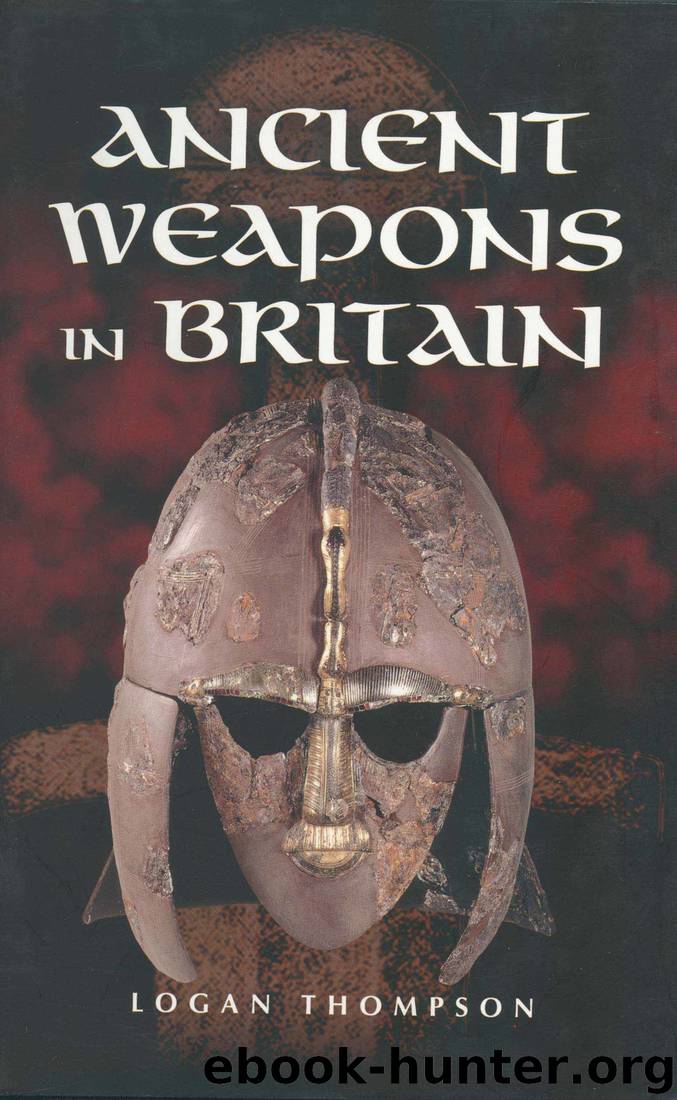
Ancient Weapons in Britain by Logan Thompson
Author:Logan Thompson [Thompson, Logan]
Language: eng
Format: epub
Tags: Mlitary, Medieval, Weapons & Warfare, Ancient
ISBN: 1844151506
Goodreads: 23081491
Publisher: Pen & Sword
Published: 2005-01-01T05:00:00+00:00
The weapons of most Anglo-Saxon warriors comprised the shield, spear, javelin and scramasax. Unlike the javelin, the spear was not hurled at opponents, because such action would naturally deprive the warrior of his main arm. In contemporary battles, men did not deploy in the regimented, highly disciplined interlocked ranks so splendidly demonstrated by the Roman army. Instead, they fought in a close-quarters mêlée that was a chaotic, confusing and dangerous situation where numerous individual man-to-man conflicts took place simultaneously. The shield provided vital protection while the spear was vigorously directed with overarm or upward thrusts at any weakly guarded parts of an adversary’s body. It was a period of stimulating, adrenalin-pumping struggle that demanded great courage. Survival also depended on physical fitness and the ability to duck and weave to avoid an opponent’s lunge and recover to an advantageous position from which a decisive stroke could be delivered. If the spear was broken, accidentally dropped, or became too firmly embedded in an antagonist’s shield or body the warrior was momentarily defenceless. He then resorted to employing his scramasax if there was no discarded spear immediately available that could be safely snatched up and used. Long-bladed scramasaxes could be wielded in over-the-shoulder or sideways arm-slashing strokes, the heavy blade inflicting significant wounds. Its long, pointed blade, reinforced by the very heavy blade back, also made it a good thrusting weapon guaranteed to penetrate contemporary protective clothing and cause deep, fatal wounds.
We have now examined the Anglo-Saxon scramasax and noted how it was a popular second-line arm for some four centuries. Its retention for such a long period is proof of its effectiveness and dependability. Apart from successful combat use it was doubtless employed in a multitude of tasks which have occupied soldiers since ancient times. In this, it was rather similar to the 19th century sword bayonet, which was employed for woodcutting, carpentry, game butchery and cooking. As a supplement to the spear and shield it was a versatile, useful and practical weapon.
Winchester seax or scramasax dagger with fairly complex pommel and thin oval guard, both silver plated, indicating a status arm. Either Saxon or, possibly, Frankish of 9th C. (© Copyright the British Museum)
Download
This site does not store any files on its server. We only index and link to content provided by other sites. Please contact the content providers to delete copyright contents if any and email us, we'll remove relevant links or contents immediately.
Whiskies Galore by Ian Buxton(42089)
Introduction to Aircraft Design (Cambridge Aerospace Series) by John P. Fielding(33180)
Small Unmanned Fixed-wing Aircraft Design by Andrew J. Keane Andras Sobester James P. Scanlan & András Sóbester & James P. Scanlan(32836)
Aircraft Design of WWII: A Sketchbook by Lockheed Aircraft Corporation(32336)
Craft Beer for the Homebrewer by Michael Agnew(18290)
Turbulence by E. J. Noyes(8132)
The Complete Stick Figure Physics Tutorials by Allen Sarah(7428)
The Institute by Stephen King(7096)
The Thirst by Nesbo Jo(7016)
Kaplan MCAT General Chemistry Review by Kaplan(6991)
Bad Blood by John Carreyrou(6676)
Modelling of Convective Heat and Mass Transfer in Rotating Flows by Igor V. Shevchuk(6496)
Weapons of Math Destruction by Cathy O'Neil(6372)
Learning SQL by Alan Beaulieu(6349)
Man-made Catastrophes and Risk Information Concealment by Dmitry Chernov & Didier Sornette(6145)
Permanent Record by Edward Snowden(5908)
Digital Minimalism by Cal Newport;(5844)
Life 3.0: Being Human in the Age of Artificial Intelligence by Tegmark Max(5621)
iGen by Jean M. Twenge(5467)
